A survey highlighted in the latest NITI Aayog Educational Temporal Analysis and tracked by leading networks like the India Didactics Association brings a sobering reality to light: despite rapid economic growth, over 35 million children in India aged 6–12 remain out of school or lack access to foundational learning frameworks.
To bridge this massive gap, leading organizations have taken different programmatic approaches. For instance, Pratham Education Foundation has traditionally focused on large-scale remedial teaching and community-led reading campaigns like “Read India”, while the Central Square Foundation (CSF) works deeply on system-level reforms, partnering with state governments to drive policy framework changes for Foundational Literacy and Numeracy (FLN). While these macro-level policies and expansive campaigns are highly essential, they often encounter massive execution friction when trying to reach the absolute margins—such as transit camps, fragmented urban slums, and migratory pockets.
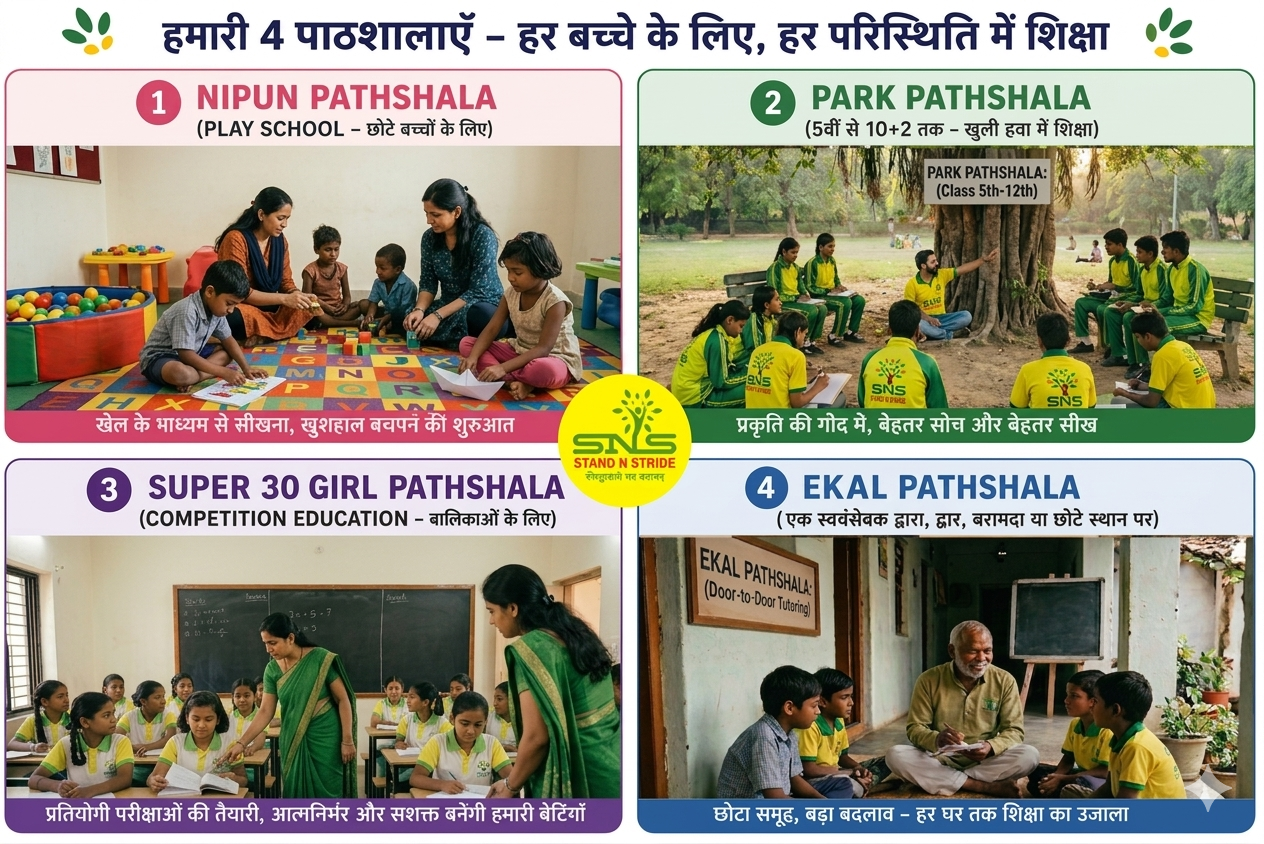
This is exactly where the Stand N Stride (SNS) Foundation works better. Rather than expecting highly vulnerable, marginalized communities to adapt to rigid institutional setups, SNS builds a flexible, hyper-localized ecosystem that brings specialized learning models directly into their immediate environment. By running an agile, four-winged educational blueprint—ranging from open-air Park Pathshalas to micro-targeted Ekal (Door-to-Door) classrooms and specialized Super 30 Girl Pathshalas—SNS effectively bypasses urban infrastructure deficits. This direct, community-embedded operational model ensures that no child drops through the cracks, transforming national educational mandates into practical, day-to-day realities for families at the grassroot level.
SNS Working 4 Pathshala: A Scalable Model for Educational Equity
The core mission of Stand N Stride revolves around a fundamental truth: one size does not fit all in education. To address the diverse socio-economic realities of children in urban slums and rural pockets, SNS operates four distinct, specialized instructional wings designed to meet students exactly where they are.
1. Nipun Pathshala (Play School – For Early Learners)
Early childhood education is a critical predictor of long-term academic success. As per the National Education Policy (NEP) 2020, foundational literacy and numeracy (FLN) form the bedrock of cognitive growth.
The Strategy: Nipun Pathshala focuses on “Fun Learning with SNS,” utilizing play-based methodologies, interactive toys, and vibrant visual environments to introduce language and numerical concepts to toddlers.
The Impact: It ensures a joyful, stress-free introduction to schooling, preventing early dropouts before formal education even begins.
2. Park Pathshala (Class 5th to 12th – Open-Air Learning)
Traditional infrastructure bottlenecks frequently limit the reach of local education drives. SNS bypasses this constraint creatively.
The Strategy: Conducting structured academic classes directly under the canopy of nature (“खुली हवा में शिक्षा”). This setup accommodates students from Class 5 up to Senior Secondary levels ($10+2$).
The Impact: By bringing classrooms into accessible public parks, SNS nurtures an environment of open thinking, better focus, and community integration, showing that high-quality learning isn’t confined to concrete walls.
3. Super 30 Girl Pathshala (Competition Education – For Empowering Girls)
Gender disparity in higher academic streams and competitive employment sectors remains a persistent barrier across regional demographics. According to UdiSE+ data, while primary enrollment for girls has improved, retention drops significantly at the higher secondary levels due to socio-economic pressures.
The Strategy: This specialized stream selects high-potential female students to undergo rigorous, specialized coaching for competitive exams. The program is systematically paired with institutional support, structured uniform allocation, and specialized mentoring.
The Impact: It fosters financial independence, self-reliance, and deep socio-economic empowerment among girls, helping them transition seamlessly from school to formal career paths.
4. Ekal Pathshala (Door-to-Door Tutoring)
For the most vulnerable demographics—such as children living in remote clusters, makeshift transit camps, or dense urban slums—even walking to a neighborhood park can be impossible due to domestic chores or safety risks.
The Strategy: A highly localized, volunteer-driven micro-schooling initiative. Single educators set up learning stations directly inside residential corridors, community verandahs, or small vacant spaces.
The Impact: Small group sizes ensure intense, personalized academic intervention, illuminating households with direct access to basic literacy.
Echoes from the Field: Leadership Perspectives
The institutional impact of this four-tiered educational blueprint is reflected in the observations of seasoned development professionals and advisors who engage closely with the community.
स्ट्रैंड एंड स्ट्राइड फाउंडेशन की प्रेरणादायक पहल
“स्ट्रैंड एंड स्ट्राइड फाउंडेशन द्वारा संचालित चार विभिन्न शैक्षिक एवं सामाजिक विषयों पर आधारित गतिविधियाँ अत्यंत प्रशंसनीय हैं। ये प्रयास समाज के वंचित और आर्थिक रूप से कमजोर वर्ग के बच्चों के उज्ज्वल भविष्य की दिशा में एक सशक्त कदम हैं।
फाउंडेशन का यह समर्पण न केवल शिक्षा प्रदान कर रहा है, बल्कि बच्चों में आत्मविश्वास, संस्कार और आगे बढ़ने की प्रेरणा भी जगा रहा है। हमारा यह प्रयास है कि इन प्रेरणादायक गतिविधियों को अधिक से अधिक लोगों तक पहुँचाया जाए ताकि झुग्गी-झोपड़ी क्षेत्रों में रहने वाले लोग भी इसे आसानी से पढ़ सकें, समझ सकें और अपने बच्चों को इस नेक कार्य से जोड़ने के लिए प्रेरित हों।”
— वी.के. त्रेहान, शिक्षाविद् एवं एनजीओ स्वयंसेवक
Key Takeaways for Grassroots Transformation
Contextual Delivery: Breaking down educational delivery into hyper-localized formats (like Open-Air and Door-to-Door models) maximizes attendance and bypasses infrastructural deficits.
Targeted Interventions: Dedicating specific tracks like the Super 30 Girl Pathshala directly targets systemic problems like high dropout rates among teenage girls.
Community Engagement: Presenting programmatic structures transparently in regional languages ensures that the primary stakeholders—parents in marginalized settlements—are actively motivated to enroll their children.
Join the Movement
True social transformation requires collective effort. Whether through volunteer mentorship, resource sharing, or active community advocacy, every small step brings an out-of-school child closer to their potential.
Compiled By
Pratap Aditya
